More visits: Badran and Leander
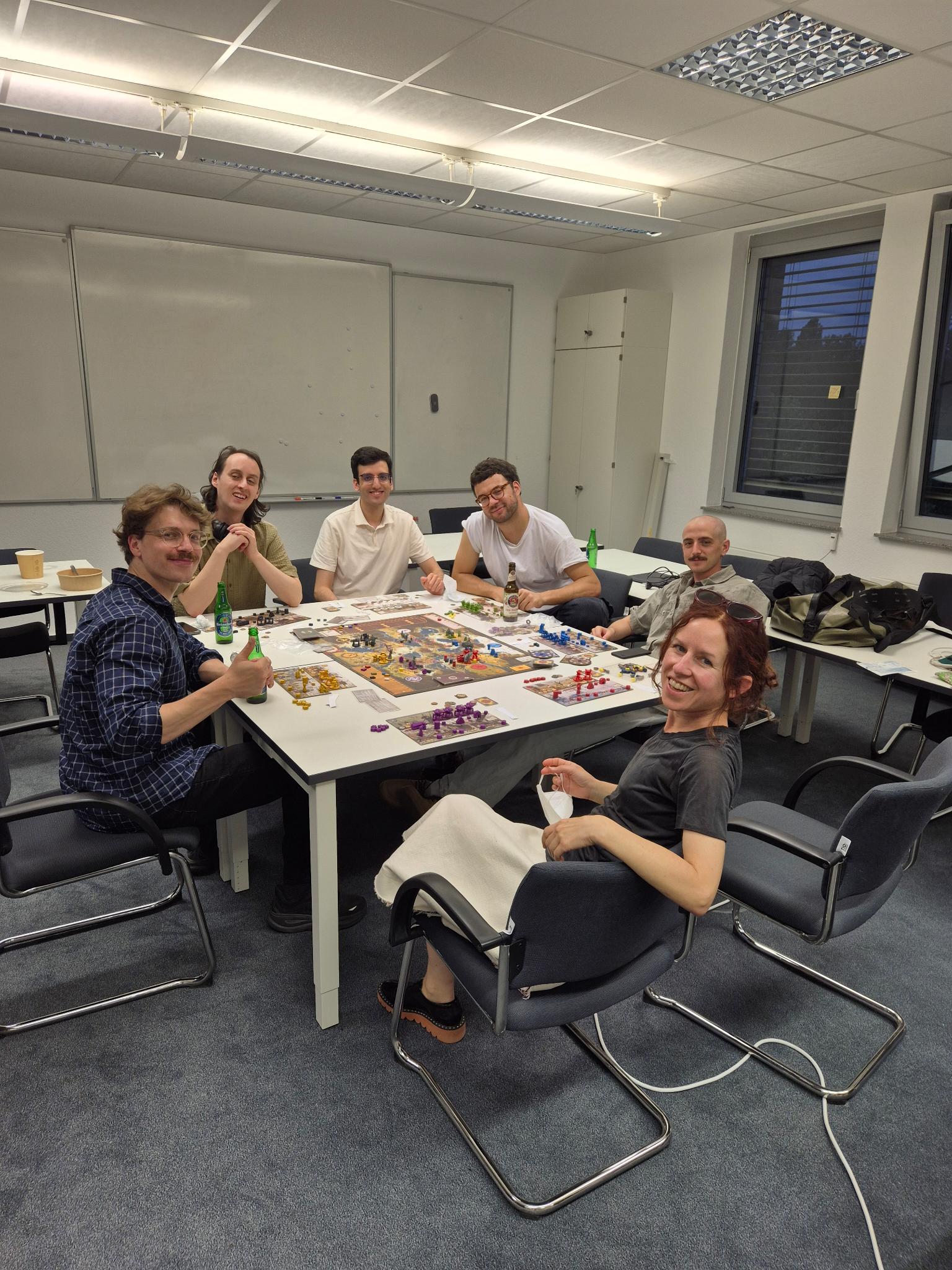
Visits by Leon Assad, Luca Redondi and Matteo Michelini: Talks, Boardgaming and Pizzas newsluca
Leon (Assad), Luca (Redondi) and Matteo (Michelini) visited us in the week from 6th to 10th of July. We had a mini workship with talks by Leon on “What do you mean by likely?” and Matteo talked on “The Emergence and Stabilization of Scientific Pluralities”.
Leon Assad on “What do you mean by likely?” newstalksABMs
← Visits by Leon Assad, Luca Redondi and Matteo Michelini: Talks, Boardgaming and Pizzas
Leon Assad gave a talk “What do you mean by ‘Likely’? How ambiguous testimony leads to polarization and wrong beliefs”.
Group deliberation has two aims: to lead to consensus, and improve beliefs. But deliberation can fail: we may polarize, or converge on wrong beliefs. Increasingly, philosophers put forward mechanisms that would lead to such failure even among rational individuals—or at least boundedly rational. This paper contributes a new mechanism to that literature: ambiguous testimony. Verbal expressions of uncertainty (”likely,” ”unlikely”) are compatible with a range of underlying credences, and decades of psychological research show that listeners resolve this ambiguity in different ways. My ”likely” is not your ”likely,” and this mismatch can produce misunderstandings between speakers and listeners. Using a new agent-based model of ambiguous testimony, we show that these misunder- standings alone are sufficient to generate both polarization and entirely wrong consensus at the group level. While we do not claim that our agents are perfectly rational, we argue that a realistic depar- ture from ideal deliberation—the use of ambiguous expressions—suffices to produce both outcomes among otherwise rational agents.
Matteo Michelini on the Emergence and Stabilization of Scientific Pluralities newsmatteotalksABMs
← Visits by Leon Assad, Luca Redondi and Matteo Michelini: Talks, Boardgaming and Pizzas
Matteo Michelini gave a talk “The emergence and stabilization of scientific pluralities: a model-based approach”.
Tom-Felix abstract on AI Deception got accepted for ECAP newstomfelixAIconferences
Tom-Felix Berger’s extended abstract “The Conceptual Role of Internal Representations in Strategic AI Deception” got accepted for ECAP.
Dunja gave a talk at the Modelling in Philosophy Workshop in Stockholm on ABMs as a Philosophical Method newsdunjaworkshopstalksABMs
Dunja Šešelja gave a talk at the “Modelling in Philosophy” Workshop:
In this talk I first examine the role of highly-idealized agent-based models in philosophy, focusing on the kind of explanation they provide. After arguing that they initially always provide epistemically opaque hoe-possibly explanations, I discuss different ways in which this opaqueness can be reduced: robustness analyses, empirical evaluation and, the targeted monotonicity analysis.
Dunja gave a talk in the Higher Seminar in Philosophy at Stockholm University newsdunjatalkschristianABMsqualgrad
Dunja Šešelja gave a talk at the Higher Seminar in Philosophy at Stockholm University.
Expert Disagreement: From Individual Judgment to Collective Decision-Making
When experts make judgments that inform public policy, what kinds of reasons should they consider to provide informed and responsible recommendations? In the first part of this talk, I argue that responsible expert judgment requires sensitivity to certain social-epistemic reasons that are often overlooked in discussions on expertise. Using the COVID-19 aerosol transmission debate as an illustrative case, I show how experts must account for “higher-order evidence” arising from peer disagreement, and “inquisitive reasons” regarding the pursuit-worthiness and distribution of labor across various research programs. However, acknowledging that disagreement should inform individual expert judgment raises a challenge for collective decision-making: how should advisory boards aggregate those divided opinions into a policy recommendation? To address this challenge, in the second part of the talk I presents an agent-based model comparing different decision-making strategies in the context of expert disagreement, and their impact on successful policy-making and on public trust in science. Our results show that no decision-making strategy is optimal across different scenarios. Moreover, there is a trade-off between strategies that maximize successful policy-making and those that maximize public trust in science. (The first part of the talk is based on joint work with Will Fleisher and Daniel C. Friedman; the second part is based on joint work with Leah Henderson and Christian Straßer).
Christian gave a talk in Hagen on Inconsistency Measures newschristianbadranAItalks
Christian gave a talk in Matthias Thimm’s group in Hagen on joint work with Badran Raddaoui and Said Jabbour.
Here’s the abstract:
In this talk, I provide an overview of recent work on measuring and reasoning in the presence of inconsistency. First, building on joint work with B. Raddaoui and S. Jabbour, I present a novel correction-based inconsistency measure that enforces structural transparency and sensitivity --- what we call ‘structural additivity’. Measures should strictly reflect the introduction of new conflicts, cleanly separate independent knowledge bases, and symmetrically distribute inconsistency weight across structurally equivalent components. Second, in collaboration with O. Arieli and B. Raddaoui, I examine the status of free formulas. Surprisingly, I argue that even formulas outside minimal conflicts can differ in their defeasible reliability. This insight enables refined models of cautious paraconsistent reasoning that exploit subtle distinctions among free formulas. Finally, if time permits, I discuss joint work with O. Arieli, K. van Berkel, and B. Raddaoui on conflict-tolerant deontic logic. By integrating inconsistency measures into deontic logic, we define nonmonotonic entailment relations that quantify how individual norms contribute to deontic conflicts. These measure-driven recommendations allow agents to derive obligations that actively minimize normative violations. In sum, these approaches show how formal quantification, semantic refinement, and logical integration assist in inconsistency-tolerant reasoning.
Reading Group for Qualitative Grading Project newsqualgraddunjachristianminkyungissam
We kicked off the hybrid and weekly reading group for the Research Project: Qualitative Grading in Science together with Thomas Boyer-Kassem and interested friends like Martin Justin and Piero Avitabile. We’re open … if you’re interested, let us know :-)
New paper in KR 2026 newschristianbadranoferAIconferences
← Guests
A new paper “Beyond Consistency: A Closer Look at Free Formulas” by Ofer Arieli, Badran Raddaoui and Christian Straßer got accept for KR 2026. It introduces new and highly cautious forms of defeasible reasoning, that is inconsistency-tolerant Nonmonotonic Logics, with some connections to inconsistency measures. In this paper, we describe methods for drawing conclusions from inconsistent information in a particularly cautious manner. These approaches to cautious paraconsistent reasoning are especially useful in situations where the outcomes of the conclusions are irreversible or have far-reaching consequences in the given context. Such inference methods are therefore more restrictive than standard approaches to reasoning under inconsistency, which rely on (the formulas in the intersection of) consistent subsets of the knowledge base. In particular, the reasoning methods under consideration allow to infer only those conclusions that are fully guaranteed, namely those that are in no way affected by the inconsistencies in the base. The paper presents several techniques for implementing cautious paraconsistent reasoning and compares their basic properties and relative strengths. (Arieli et al., 2026)
  @InProceedings{arieli-raddaoui-strasser-KR-26,
  author = 	 {Ofer Arieli and Badran Raddaoui and Christian Stra{\ss}er},
  title = 	 {Beyond Consistency: A Closer Look at Free Formulas},
  booktitle =	 {Proceedings of KR 2026},
  year =	 {2026},
  note =	 {Forthcoming},
}