


Modulation of Glutamate Receptors by Auxiliary Proteins
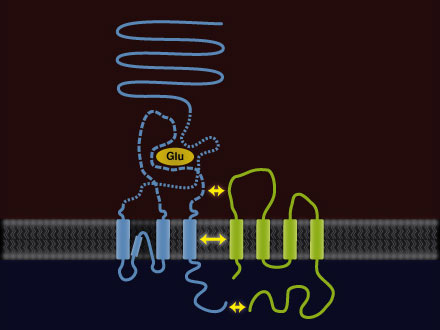 AMPA receptors are a subfamily of ionotropic glutamate receptors and play a crucial role in fast signal transduction in the brain. Although AMPA receptors can exert their basic function, i.e., fluxing ions into the cell upon binding of glutamate, on their own, many other proteins are involved in the fine tuning of this process. Most of these proteins are important for transporting the AMPA receptors to their correct destination when they are needed, but also for removing them when they are not needed any more. The discovery of a family of six small membrane proteins that are also involved in this regulation of transport, but in addition directly change the functional properties of AMPA receptors, was a surprising achievement. In particular, these transmembrane AMPA receptor regulatory proteins (TARPs) boost the glutamate-induced signal by increasing the opening time of the AMPA receptor channel. To understand the function of AMPA receptors, it is important to understand this mechanism. We are particularly interested in characterising the different impacts of the different TARPs on AMPA receptors and investigate the interactions that form the basis of this differential modulation.
Project-Related Publications
- A. Bećić, J. Leifeld, J. Shaukat, and M. Hollmann (2022).
Tetraspanins as potential modulators of glutamatergic synaptic function.
Frontiers in Molecular Neuroscience 14: 801882.
doi: 10.3389/fnmol.2021.801882
Abstract
- S.C. Haering, D. Tapken, S. Pahl, and M. Hollmann (2014).
Auxiliary subunits: Shepherding AMPA receptors to the plasma membrane.
Membranes 4(3): 469-490.
doi: 10.3390/membranes4030469
Abstract
- C. Sager, D. Tapken, and M. Hollmann (2010).
The C-terminal domains of TARPs: Unexpectedly versatile domains.
Channels 4(3): 155-158.
doi: 10.4161/chan.4.3.11349
Abstract
- C. Sager, J. Terhag, S. Kott, and M. Hollmann (2009).
C-terminal domains of transmembrane α-amino-3-hydroxy-5-methyl-4-isoxazole propionate (AMPA) receptor regulatory proteins not only facilitate trafficking but are major modulators of AMPA receptor function.
Journal of Biological Chemistry 284(47): 32413-32424.
doi: 10.1074/jbc.M109.039891
Abstract
- S. Kott, C. Sager, D. Tapken, M. Werner, and M. Hollmann (2009).
Comparative analysis of the pharmacology of GluR1 in complex with TARPs γ2, γ3, γ4, and γ8.
Neuroscience 158(1): 78-88 (Special issue “Protein Trafficking, Targeting, and Interaction at the Glutamate Synapse”).
doi: 10.1016/j.neuroscience.2007.12.047
Abstract
- C. Sager, D. Tapken, S. Kott, and M. Hollmann (2009).
Functional modulation of AMPA receptors by transmembrane AMPA receptor regulatory proteins.
Neuroscience 158(1): 45-54 (Special issue “Protein Trafficking, Targeting, and Interaction at the Glutamate Synapse”).
doi: 10.1016/j.neuroscience.2007.12.046
Abstract
- C. Körber, M. Werner, S. Kott, Z.-L. Ma, and M. Hollmann (2007).
The transmembrane AMPA receptor regulatory protein γ4 is a more effective modulator of AMPA receptor function than stargazin (γ2).
Journal of Neuroscience 27(31): 8442-8447.
doi: 10.1523/jneurosci.0424-07.2007
Abstract
- C. Körber, M. Werner, J. Hoffmann, C. Sager, M. Tietze, S.M. Schmid, S. Kott, and M. Hollmann (2007).
Stargazin interaction with α-amino-3-hydroxy-5-methyl-4-isoxazole propionate (AMPA) receptors is critically dependent on the amino acid at the narrow constriction of the ion channel.
Journal of Biological Chemistry 282(26): 18758-18766.
doi: 10.1074/jbc.M611182200
Abstract
- S. Kott, M. Werner, C. Körber, and M. Hollmann (2007).
Electrophysiological properties of AMPA receptors are differentially modulated depending on the associated member of the TARP family.
Journal of Neuroscience 27(14): 3780-3789.
doi: 10.1523/jneurosci.4185-06.2007
Abstract Pressemitteilung
Project-Related Doctoral Theses
- Peer Henning Höcker
Identification of domains relevant for AMPA receptor modulation by stargazin
March 2012 to April 2017
- Sandra Lemos
Modulation of AMPA receptors by type-II TARPs
April 2011 to March 2017
Download thesis as pdf (7.2 MB)
- Jan Terhag
Auxiliary subunits of voltage-gated calcium channels as modulators of ionotropic glutamate receptors
October 2008 to June 2016
Download thesis as pdf (51.2 MB)
- Simon Haering
Identification and functional characterization of claudin subunits as new transmembrane AMPA receptor regulatory proteins
November 2010 to September 2015
Download thesis as pdf (22.8 MB)
- Charlotte Sager
Investigations on the interaction of AMPA receptors with TARPs
October 2006 to July 2010
Download thesis as pdf (5.4 MB)
- Sabine Kott
Characterisation of the functional modulation of AMPA receptors by TARPs
March 2003 to July 2008
Download thesis as pdf (2.8 MB)
Project-Related Master Theses
- Hua Tan
Investigation of AMPAR–stargazin interactions using split GFP fluorophore reassembly
24.02.2014 to 24.08.2014
- Tobias Strasdeit
Electrophysiological investigations of new glutamate receptor-modulating proteins
23.07.2013 to 29.07.2014
- Peer Henning Höcker
Studies of the mechanism of modulation of AMPA receptors by type I TARPs
01.10.2010 to 24.10.2011
- Christoph Körber
Modulation of the electrophysiological properties of AMPA receptors by TARPs
01.03.2006 to 27.09.2006
- Charlotte Sager
Characterisation of the differential modulation of AMPA receptors by TARPs
01.03.2006 to 31.08.2006
Project-Related Bachelor Theses
- Jennifer Leifeld
Identification of TARP domains that interact with AMPA receptors
Supervisor: Peer Henning Höcker
- Lena Schüle
Modulation of heteromeric kainate receptors by NETO proteins
Supervisor: Steffen Pahl
- Oliver Lampret
Investigations on the functional modulation of NMDA receptors by interacting membrane proteins
Supervisor: Simon Kösters
- Felix Kipper
Investigations on the functional significance of conserved serine residues in the C-terminal domain of the TARP γ2
Supervisor: Peer Henning Höcker
- Isabella Tolle
Functional modulation of NMDA receptors by the accessory subunits CKAMP44a and CKAMP44b
17.09.2012
Supervisor: Simon Kösters
- Daniela Keinhörster
Electrophysiological investigations of a potential modulation of AMPA and NMDA receptors by NETO proteins
10.09.2012
Supervisor: Steffen Pahl
- David Gnutt
The chaperone GRP78 as a potential interaction partner of ionotropic glutamate receptors
07.11.2011
Supervisor: Jan Terhag
- Sebastian Becker
Functional modulation of point mutants of the AMPA receptor GluA1 by TARPs
21.09.2011
Supervisor: Simon Kösters
- Daniel Niedieker
Modulation of the AMPA receptor GluR1 by the α2δ subunit of voltage-gated calcium channels
09.2010
Supervisor: Jan Terhag
- Alina Dressler
The role of the Ex1 domain of stargazin in the modulation of AMPA receptor function
05.10.2009
Supervisor: Charlotte Sager
- Ellen Kloosterboer
Generation and characterization of truncated stargazin proteins
01.10.2009
Supervisor: Dr. Sabine Kott
- Markus Sudbrock
Cloning of an AMPA receptor-stargazin fusion protein and its expression in Xenopus oocytes
11.08.2005
Supervisor: Dr. Ralf Trippe
- Romy Marx
The effect of stargazin on the expression of the glutamate receptor GluR1(Q)flip
23.06.2004
Supervisor: Dr. Ralf Trippe
 Javeria Shaukat
 Jennifer Leifeld
 Sebastian Obst
 Dr. Tobias Strasdeit
 Dr. Peer Henning Höcker
 Dr. Markus Werner
 Dr. Sandra Lemos
 Dr. Jan Terhag
 Dr. Steffen Pahl
 Dr. Simon Haering
 Dr. Charlotte Sager
 Dr. Sabine Kott
 Christoph Körber